Squash in the mac and cheese. Zucchini in the muffins. Carrots blended into the pasta sauce. If you've ever slipped a vegetable into a lunch and said nothing, you're in good company.
It makes sense. You pack a lunch with care, and the carrots come home untouched, again. Hiding a few vegetables feels like a quiet win.
So does it work? Partly. Here's what the research says, 15 swaps you can try this week, and how to keep the lunchbox safe until noon.
Does hiding vegetables work?
Hiding can add vegetables. In a Penn State study published in the American Journal of Clinical Nutrition, 39 children ages 3 to 6 ate familiar meals, like pasta and a chicken casserole, made with pureed vegetables mixed in. Their vegetable intake nearly doubled, and they liked the meals about as much as the regular versions. The researchers suggested using this along with other ways of serving vegetables, like snacks and side dishes.
Seeing and tasting builds liking. In a study of 360 fourth and fifth graders in Louisiana, kids were offered a small taste of carrots, peas, tomatoes and bell peppers once a week for ten weeks. For kids who started out disliking the vegetables, liking for carrots, peas and tomatoes went up. It didn't change for bell peppers, and it didn't work for every child.
So hidden vegetables are a useful extra. They aren't a replacement for putting a carrot stick in the box, even if it comes home again a few times.
15 lunchbox swaps to try
Each swap keeps something your child already knows. "Hidden" means the vegetable is mixed in. "Seen" means it's right there on the plate.
- 1. Mac and cheese → squash mac and cheese Stir pureed butternut squash or cauliflower into the cheese sauce. Pack it hot in a thermos. Hidden.
- 2. Pasta with jar sauce → blended veggie sauce Blend the sauce with cooked carrots, zucchini or red pepper. Hidden.
- 3. Store-bought muffin → zucchini or carrot muffin Bake a batch, freeze them, and pack one frozen. It thaws by lunch. Hidden.
- 4. Plain quesadilla → bean and sweet potato quesadilla Spread refried beans and a little mashed sweet potato under the cheese. Hidden.
- 5. Juice pouch → homemade smoothie Blend banana, berries, yogurt and a handful of spinach. Pack it in a cold insulated bottle. Hidden.
- 6. Pancakes for lunch → pumpkin mini pancakes Add canned pumpkin to the batter. Pack with a little yogurt to dip. Hidden.
- 7. Cookie → oat energy bites Oats, peanut or sunflower butter, honey and a spoon of ground flax. Hidden.
- 8. Egg sandwich → spinach egg muffins Whisk eggs with chopped spinach and cheese, bake in a muffin tin, and pack two cold. Hidden.
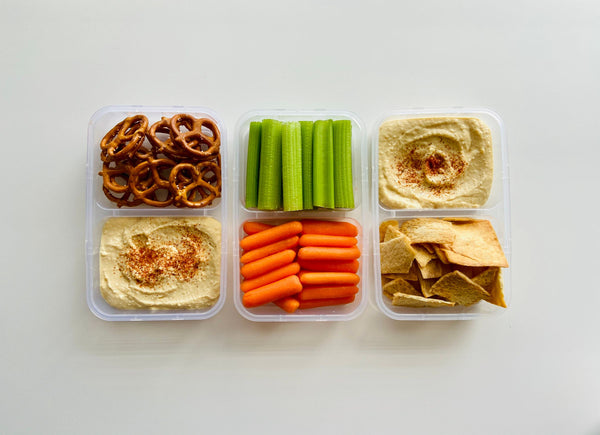
- 9. Chips → pretzels and hummus Add a few cucumber rounds for dipping. Seen.
- 10. Fruit snacks → frozen grapes or berries Frozen fruit doubles as a cold pack. Cut grapes small for younger kids. Seen.
- 11. Pizza lunch kit → DIY pizza box Crackers, a small cup of pizza sauce, shredded mozzarella and a few pepper strips. Seen.
- 12. Ranch cup → yogurt ranch Plain yogurt mixed with ranch seasoning, with snap peas or carrots. Seen.
- 13. Plain sandwich → pinwheels Spread a tortilla with cream cheese, add thin cucumber or spinach, roll it up and slice. Seen.
- 14. White-bread PB&J → whole-wheat PB and banana Use sunflower butter if your school is nut-free. Seen.
- 15. Juice box → frozen water bottle Freeze it the night before. It keeps lunch cold, then it's a cold drink. Swap the drink.
The "one new, two safe" rule
Here's a simple way to use both ideas from the research without turning lunch into a battle:
- Two safe foods. Pack two things your child already eats, so they won't go hungry.
- One small new or "seen" vegetable. A few snap peas, two cucumber rounds, three cherry tomatoes cut in half. Small is fine.
- No pressure. Don't ask why it came home. Just pack it again next week.
This fits the division of responsibility in feeding, a widely used approach: you decide what goes in the lunchbox, and your child decides whether to eat it and how much. It takes the fight out of it. The vegetable is just there, week after week.
If you do hide vegetables, you don't have to keep it a secret forever. Some families make it a game: "Guess what's in the muffins?" Others just say it plainly, "These are zucchini muffins," and leave it at that.
Keep the lunchbox cold and safe
A lunch packed at 7 a.m. may sit until noon. The USDA's back-to-school lunch tips say:
- Use two cold sources Gel packs, a frozen water bottle or a frozen juice box, one above and one below foods like meat, eggs and dairy.
- Use an insulated lunchbox The USDA says paper bags are not a safe choice for perishable food.
- Keep hot food hot Fill the thermos with boiling water for a few minutes, pour it out, then add the hot food and close the lid.
- Clean the lunchbox often And wash hands for at least 20 seconds before packing.
Food that stays between 40 and 140 °F for more than two hours should be thrown away.
The job behind the lunchbox
Swaps are the easy part. The harder part is everything around them: noticing the bread is almost gone, freezing the ice packs, checking the school menu, emptying the lunchbox that came home on Friday.
That work is real, and in many homes it lands on one parent. If that's you, read Who Packs the Lunches? How to Share the School Food Job. It has a checklist of the hidden school-food jobs and a script for handing one off.
Packed lunches, snack restocking, allergy-safe food planning and lunchbox cleaning are all jobs in the 120-job inventory inside The Mental Load Handoff (page 9). It's a 28-page printable guide for two adults who want to share household work, with word-for-word scripts and a worked example of a full handoff on page 17. It needs another adult who is willing to take on jobs.
Need after-school ideas too? See 25 easy after-school snacks and a plan for the hungry hour.